
Z-Image-Turbo vs Nano-Banana 2: Real vs Realer
With AI image generation getting scary-good, a subtle war is brewing — not between fake and real, but between what looks real and what feels real.
And while everyone’s chasing the next big checkpoint — Nano-Banana-Pro this, Banana-that, Midjourney-whatevers — Z-Image-Turbo quietly dropped and started proving a point.
It’s not the flashiest model, but it might just be the most honest.
And to be straight with you:
this free model punches way above its weight.
It’s fast, cinematic, and dangerously close to the kind of realism brands actually pay photographers for — just in a different way than you’d expect.
The Feel?
At first glance, Nano-Banana 2 seems like the one built for realism.
And technically, it is.
Its output is clean, clinical, and beautifully polished — the kind of image you’d expect from a $20K medium-format setup and a top-tier retoucher.
But Z-Image-Turbo takes a different route.
It’s not clean — it’s alive.
The tones are warmer.
The highlights breathe.
The falloff feels optical, not digital.
It’s less “corrected” and more captured.
Where Nano-Banana 2 nails commercial realism — perfect skin tones, precise lighting, balanced compositions — Z-Image-Turbo delivers a more RAW, lens-driven aesthetic that feels like it came straight off a roll of Kodak Portra 400 at golden hour.
Nano-Banana gives you the billboard.
Z-Image-Turbo gives you the behind-the-scenes still everyone actually wants to post.
Real-World Ready
Z-Image-Turbo isn’t built for showing off — it’s built for production.
A 6B-parameter text-to-image engine from Tongyi-MAI, it’s designed for environments where speed, consistency, and visual truth matter equally.
Eight sampling steps. Sub-second latency. 16 GB VRAM friendly.
It’s a model you can actually use — not just admire.
In testing, it handled everything from editorial portraiture and beauty to product and lifestyle, maintaining a believable, human tonality that sits naturally in real-world campaigns.
If you’re building ads, client decks, or creative assets that need to feel photographed rather than AI-generated, Z-Image-Turbo gets you there faster — with less prompt acrobatics.
Why It Works
Photorealism with grit
Turbo doesn’t chase glossy perfection — it captures that subtle in-between moment. The lighting feels physical. The contrast feels earned.
Prompt fidelity
Z-Image-Turbo stays loyal to intent. Nano-Banana 2 can sometimes over-beautify, while Turbo keeps faith with what you actually asked for — ideal for storyboards, concept work, and consistent brand styling.
Production performance
Eight-step sampling makes it one of the fastest models out there without compromising quality — perfect for live previews or large-scale generation pipelines.
Accessible horsepower
Runs comfortably on a standard 16 GB GPU, making it practical for studios, freelancers, and indie teams.
Scalable realism
Efficient enough for catalogs, continuous content feeds, or high-volume campaigns — without losing that believable, natural light falloff.
The Comparison
We ran identical 1024 × 1536 prompts through both Z-Image-Turbo and Nano-Banana 2 in ComfyUI, focused on real-world creative contexts — beauty, fashion, and editorial branding.
The goal wasn’t just to test realism.
It was to test feel.
Nano-Banana 2: polished, clinical, modern — the lighting reads “studio.”
Z-Image-Turbo: deeper, grainier, slightly imperfect — the kind of frame that feels like it was pulled from a real camera.
In some tests, Nano-Banana 2 came out cleaner — smoother skin, sharper edges, perfectly balanced lighting.
But in that refinement, something shifts. The emotion softens.
Z-Image-Turbo holds its grit. It keeps the shadows, the asymmetry, the texture that makes an image feel lived-in. It stays true to the prompt, while Nano sometimes interprets it — filling in the blanks with its own creative logic.
So it leaves the question open:
Do you prefer the precision of perfection — or the imperfection that feels real?
Now, let’s look at the tests themselves.
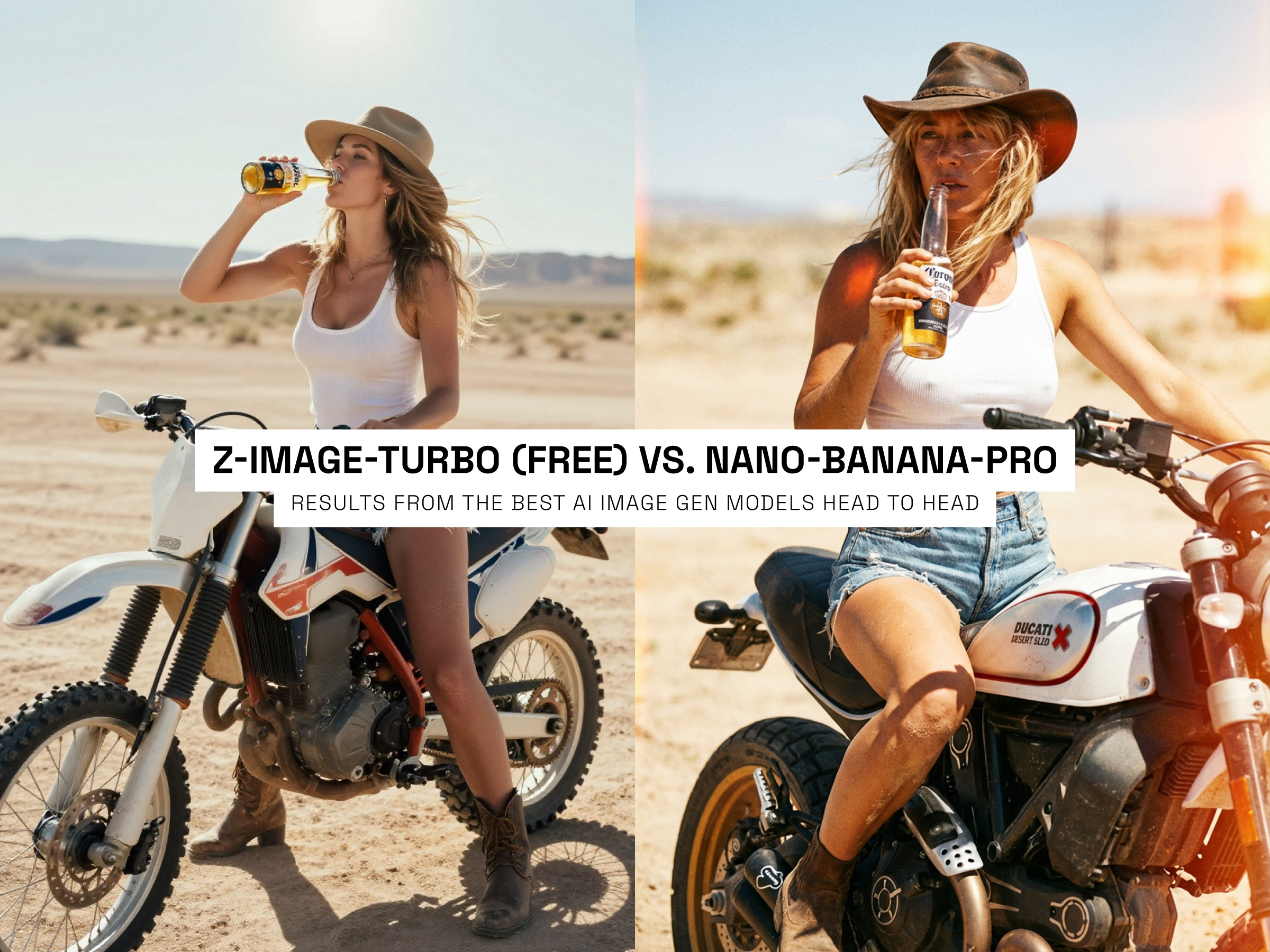
Each image was generated at 1024 × 1536 resolution using identical prompts — same composition, same parameters.
The only variable was the model itself — and the philosophy behind how it interprets reality.
You decide which one tells the truth.
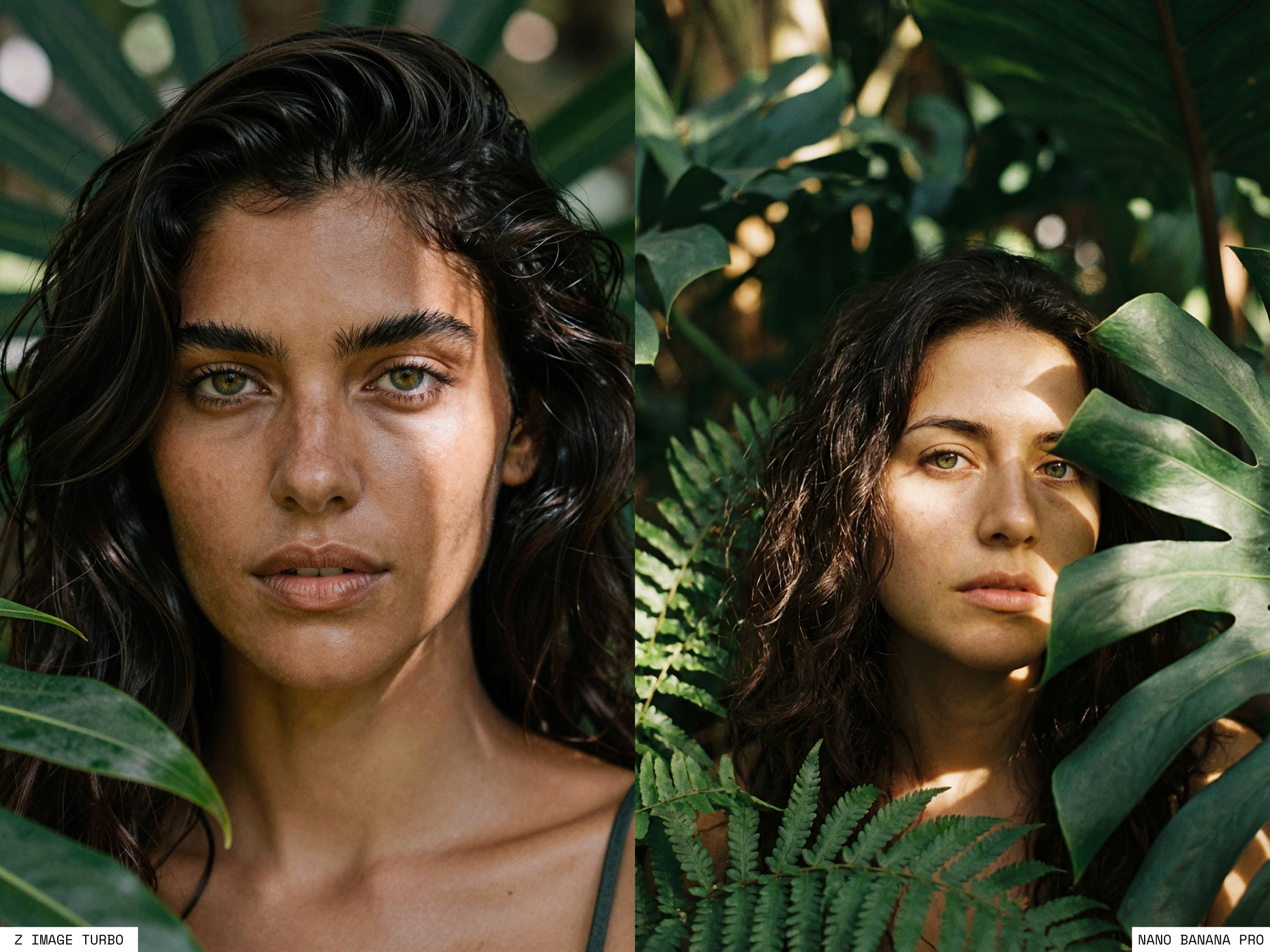
Prompt // Realistic photo, close-up of a latina model with green eyes peeking through tropical foliage, wavy dark hair, dappled sunlight on her face, natural, moody, smooth skin, a little bit of film grain.
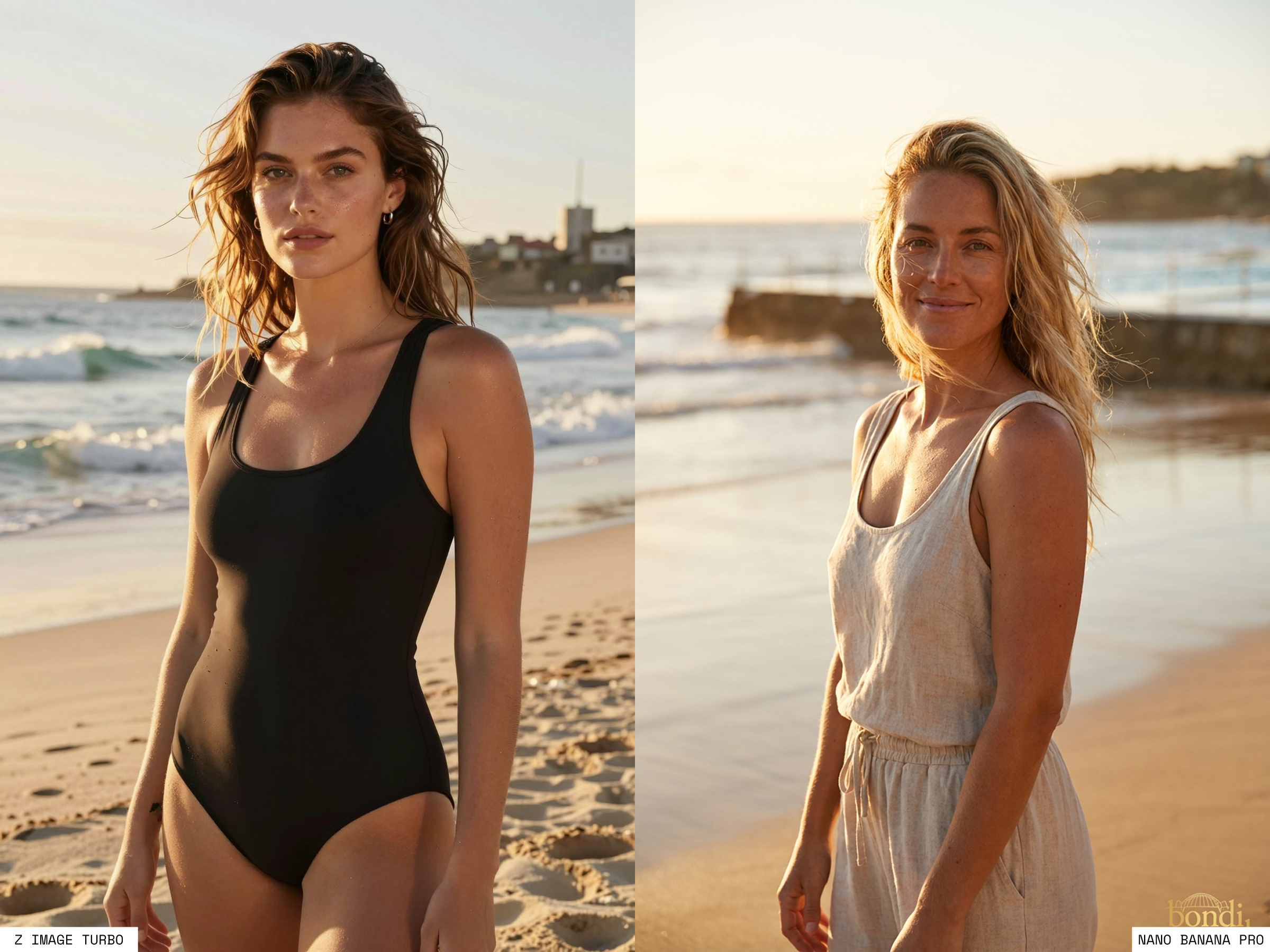
Prompt // Golden-hour portrait of a woman standing on Bondi Beach, soft ocean breeze through hair, warm backlight reflecting off the sand, glowing skin with sun-kissed highlights, cinematic depth of field, lifestyle campaign for Bondi Sands, minimal makeup, authentic Australian summer tone.
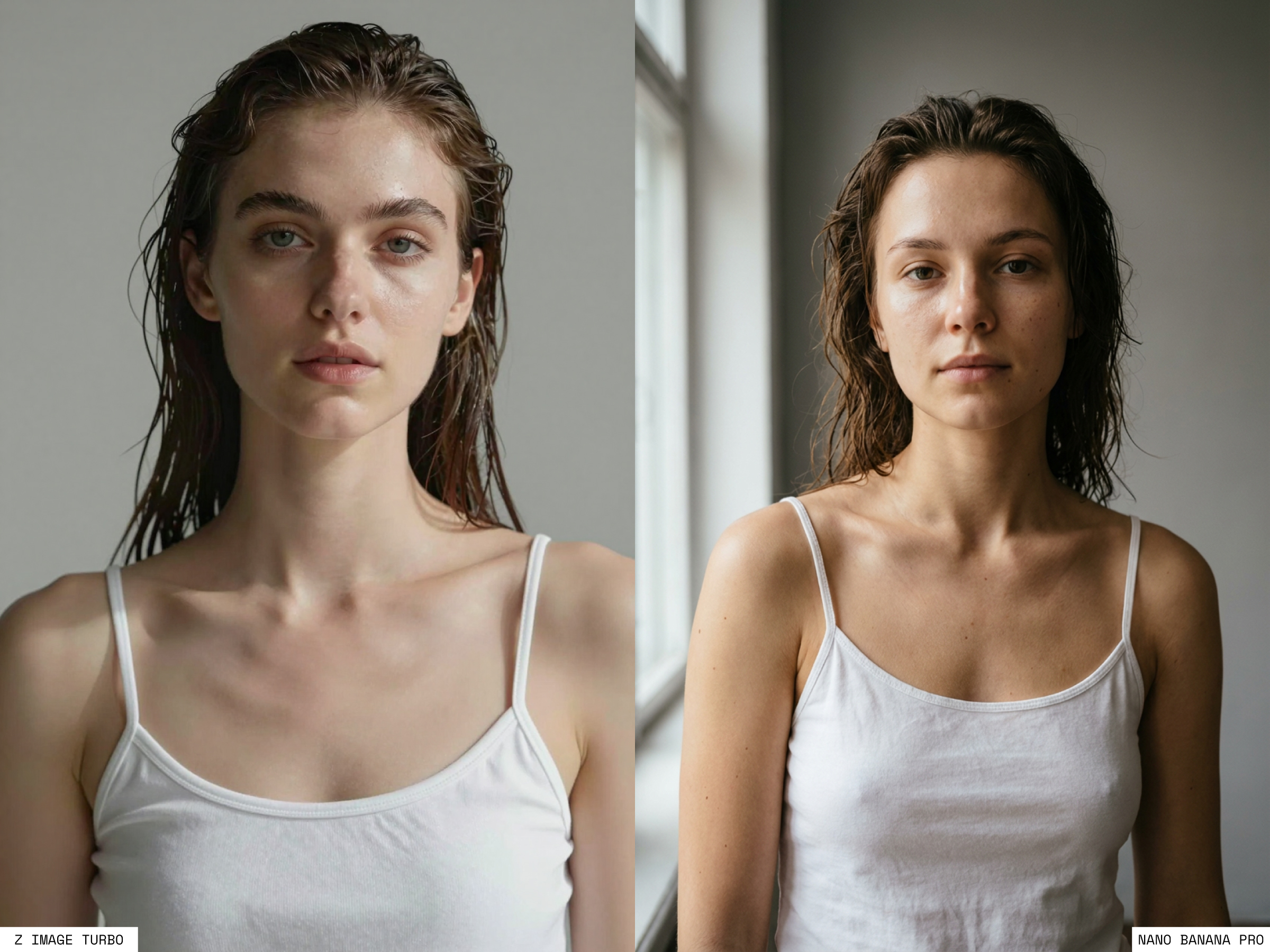
Prompt // Soft natural-light portrait closeup of a young eastern european woman with wet hair and neutral expression, wearing a thin white camisole, shot against a plain grey studio backdrop. Subtle daylight diffusion, natural skin texture, gentle shadows across collarbones, realistic tone and cinematic depth, 35mm, minimal colour grading
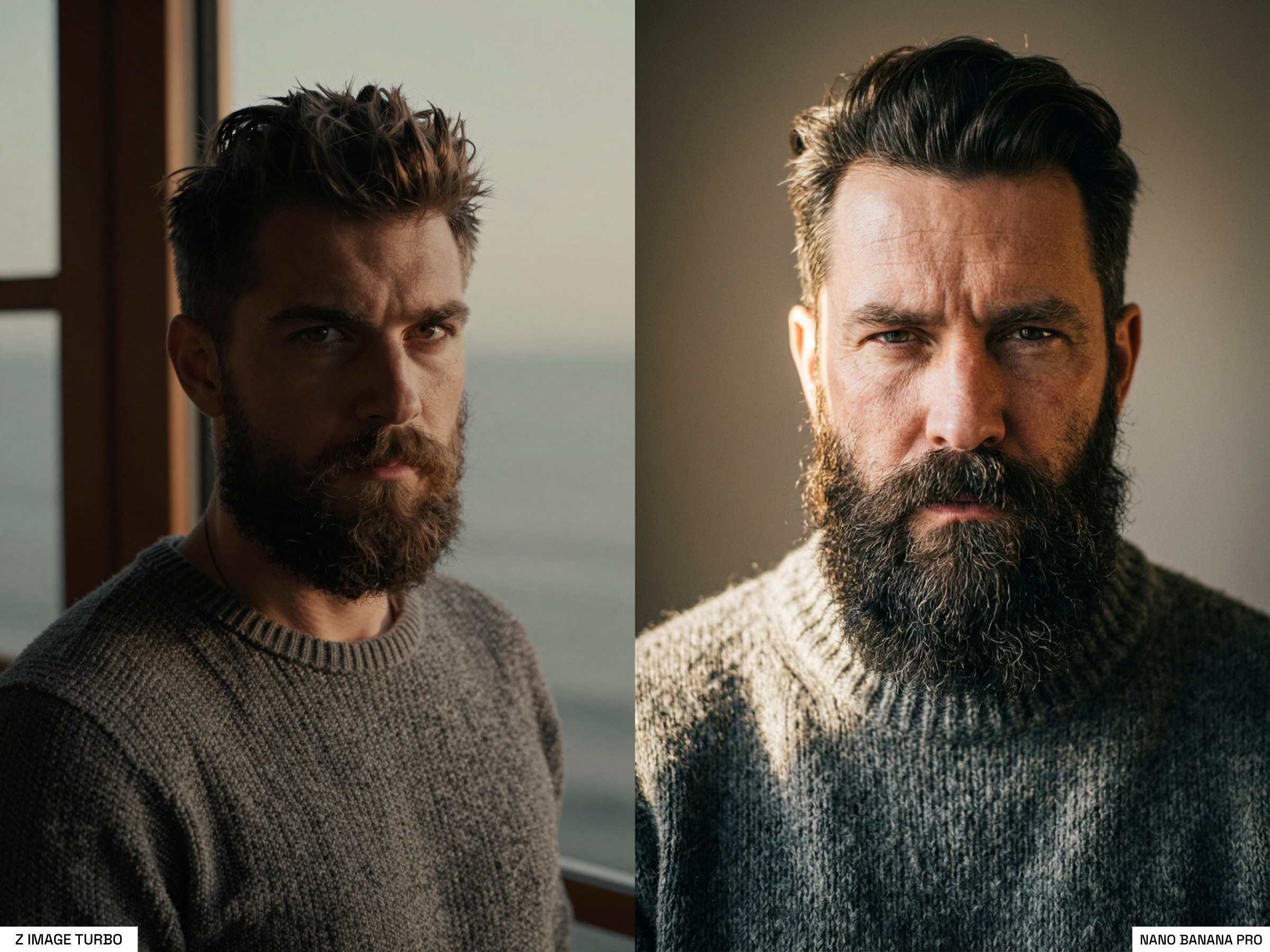
Prompt // Hyper-realistic close up portrait of a rugged maritime man with a thick dark beard and styled hair. He wears a heavy woolen grey sweater with visible coarse texture. The lighting is soft, directional, moody and warm — like northern winter sunlight through a large timber maritime window. He gazes into the camera, his expression is intense and stoic, eyes slightly narrowed, conveying quiet strength. Background is a muted, neutral gradient (warm-grey tones), shallow depth of field. The image feels raw, cinematic, and tactile — film grain and contrast preserved, natural color grading with desaturated shadows and warm highlights. Shot on a 50 mm lens, f/1.8, high contrast with subtle vignetting and lens falloff. Capture the authenticity of analog film and skin texture — avoid over-smoothing or digital perfection.
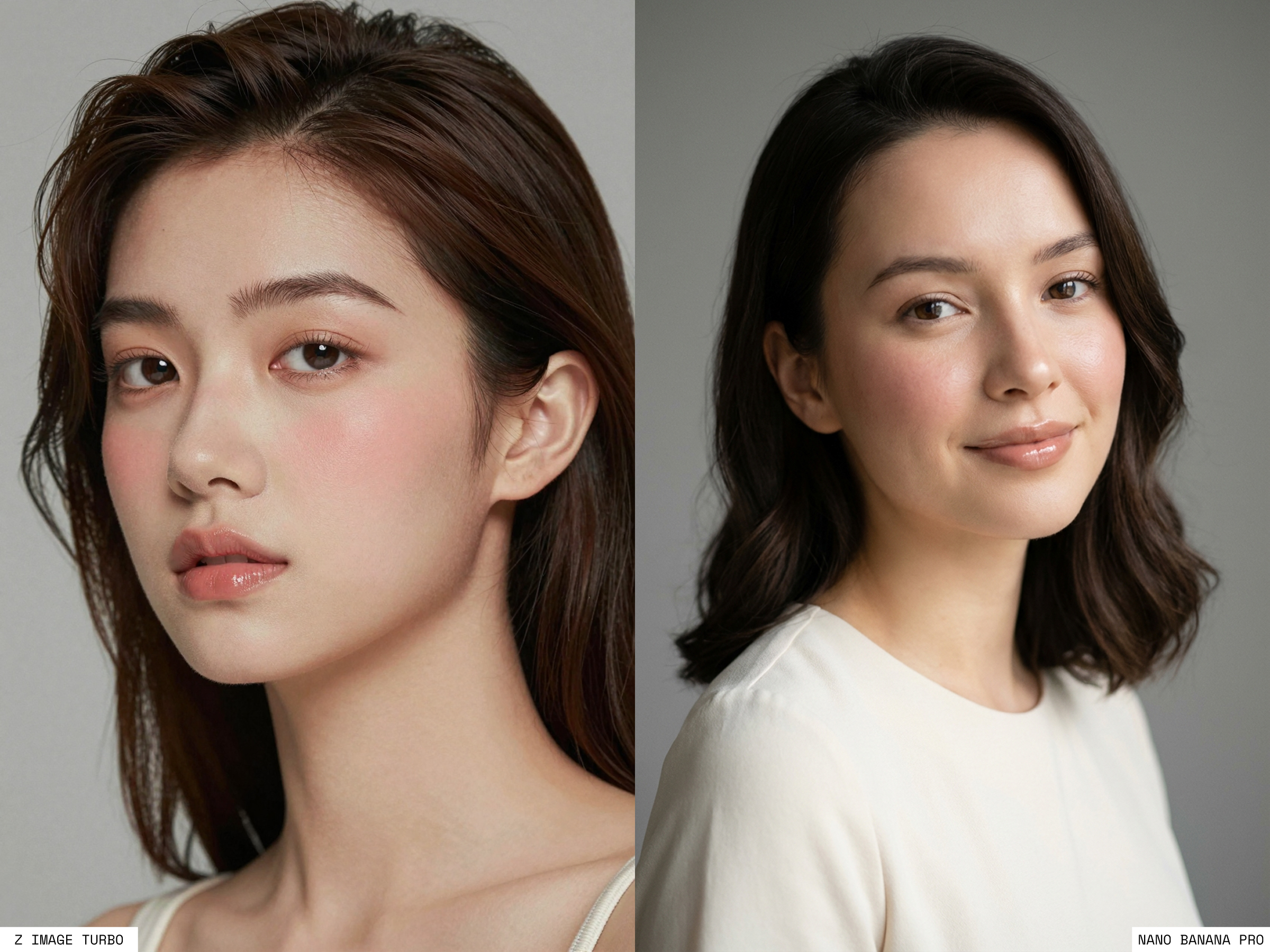
Prompt // Soft daylight portrait of a beautiful korean-beauty model with clean makeup, smooth skin texture, natural blush tones, glossy lips, and neat hair framing the face. Studio background in neutral grey, ultra-realistic detail, subtle film grain, captured with a 50 mm lens at f/2.0, editorial retro aesthetic
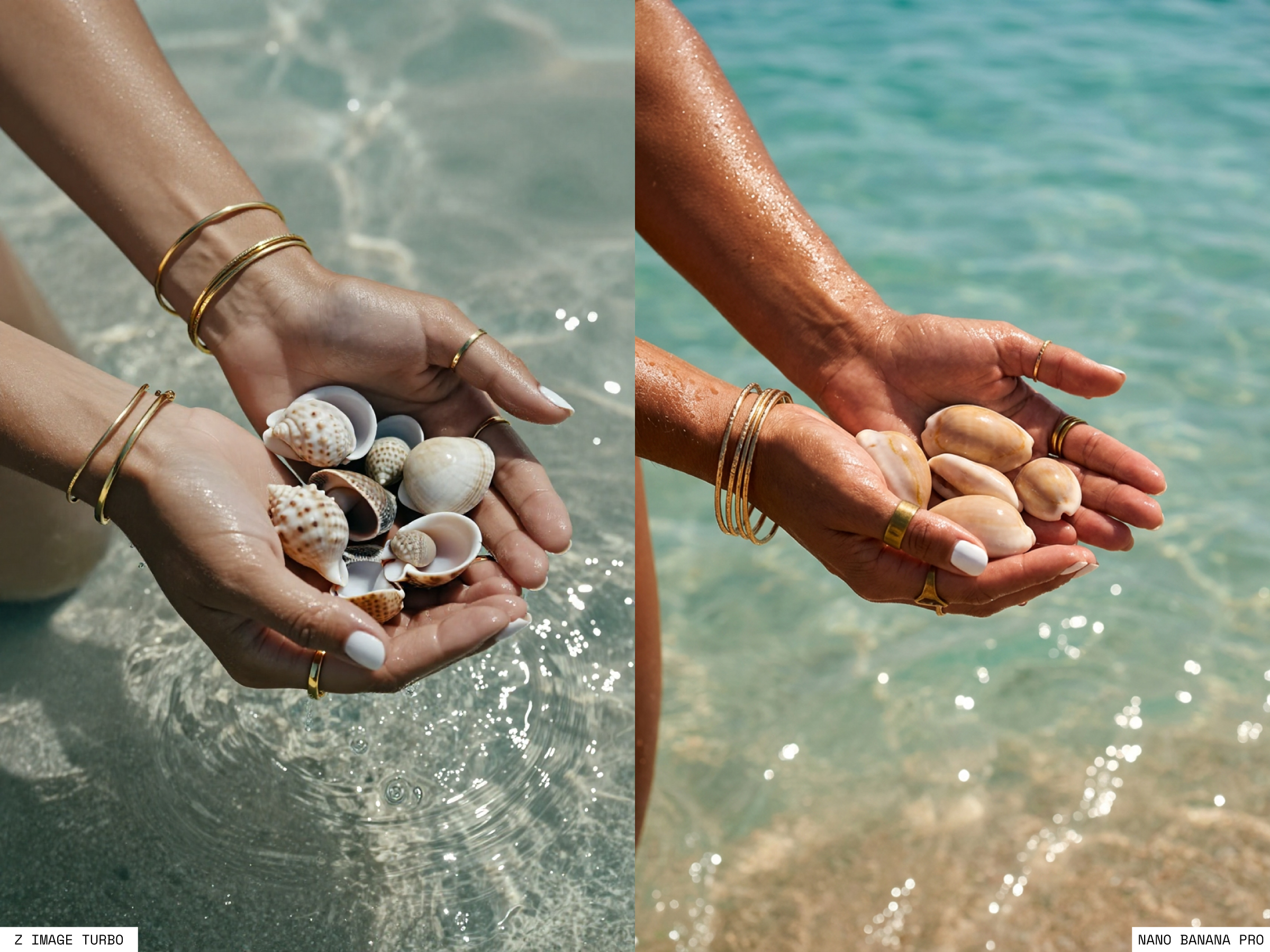
Prompt // Close-up of sunlit hands holding smooth seashells just above shallow turquoise seawater. The skin is bronzed and wet with sunlight reflecting tiny sparkles on the water surface. The person wears multiple minimal gold and brass bracelets and rings, with one hand showing white nail polish. The composition feels calm, warm, and natural — a luxury summer aesthetic with soft muted tones, gentle highlights, and rich texture. Shot in natural daylight with a shallow depth of field, cinematic lighting, editorial composition, high detail, photorealistic colour grading, premium lifestyle photography
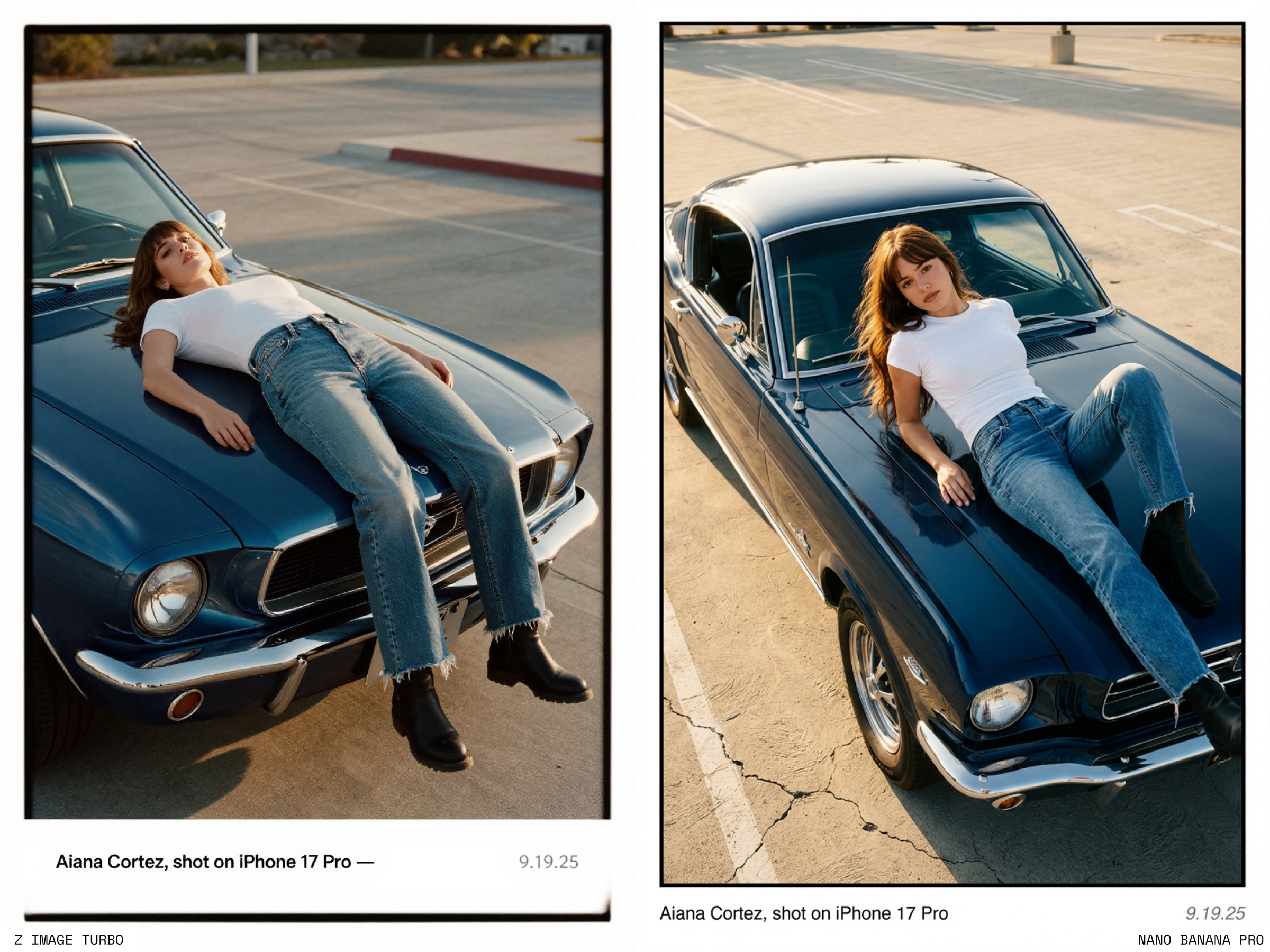
Prompt // A cinematic colour editorial photograph of a young woman lying relaxed on the hood of a vintage 1960s Ford Mustang fastback parked on concrete. The woman wears a white fitted T-shirt and faded blue denim jeans with frayed hems and black boots. Her hair is chestnut brown with a soft fringe, cascading over the car’s glossy surface. The car’s paint is deep metallic midnight blue with chrome reflections catching the warm golden hour sunlight. The background is an empty parking lot with soft shadows and a warm nostalgic tone, evoking Californian late-afternoon light. Shot on a shallow lens with natural contrast and film-like texture. Add minimalist magazine-style framing with a thin black border. Include white caption text at the bottom reading: Aiana Cortez, shot on iPhone 17 Pro — in small black Helvetica font, left-aligned. On the right bottom corner, in fine italic grey text: 9.19.25
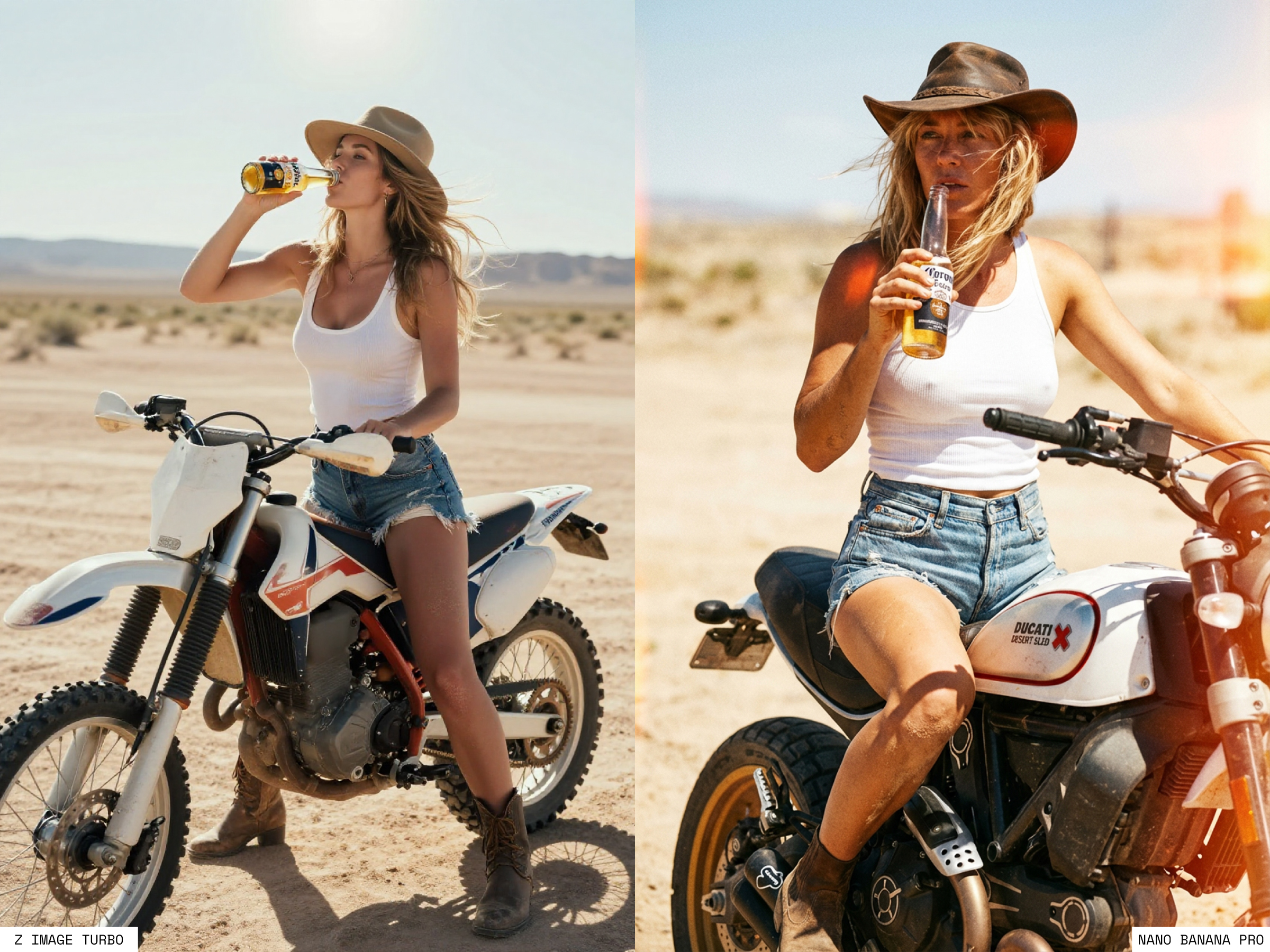
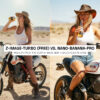
Prompt // A sun-drenched cinematic photograph of a woman sitting on a vintage Ducati Scrambler motorcycle in a desert landscape, wearing a white tank top, denim shorts, and a brown cowboy hat. She’s holding a bottle of Corona beer near her lips, looking relaxed and confident. Golden sunlight and heat haze fill the scene with warm orange tones and soft filmic lens flares. The background shows dry sand, faint mountain silhouettes, and bright midday sky. Shot on a 50mm lens, shallow depth of field, realistic skin texture, soft shadows, editorial commercial photography style, high contrast and vibrant sunlit color palette, ultra-detailed
Prompt Philosophy: Our Verdict
The prompt dynamics between Z-Image-Turbo and Nano-Banana-Pro differ less in syntax and more in philosophy.
Z-Image-Turbo seems to respond best to naturalistic, minimalist prompts — short, emotionally grounded descriptions that focus on light, texture, and tone rather than stylisation. It interprets subtle cues like “uneven lighting,” “real skin texture,” or “handheld 35 mm shot” with surprising photographic fidelity. Too many adjectives or post-processing terms can actually dilute its realism. In contrast, Nano-Banana-Pro thrives on structured, cinematic prompt engineering — detailed lens data, art direction cues, and explicit composition tags. It rewards precision and thrives when you tell it exactly what you want: lighting setup, grade type, lens focal length, camera brand, even retouching intent. The key difference?
Turbo feels the light; Nano calculates it.
Turbo trusts atmosphere and imperfection. Nano optimizes symmetry and polish.
So while both can render hyper-realism, the way you talk to them decides whether the result looks captured or constructed.
Whether you lean toward Nano-Banana’s polished precision or Z-Image-Turbo’s raw, cinematic depth, one thing’s clear — we’re past the point of asking if AI can look real. The real question now is how it makes you feel.
Scroll through the image tests below, take a closer look at the subtleties, and drop your thoughts in the comments.
Which side are you on — the perfection of the machine, or the imperfection that feels human? Tell us in the comments below – we’d love to hear your opinion!